
Appearance
Extremity customization
Three screens behind the Extremity examination.
Regions
The regions of the body an extremity finding can be recorded in — shoulder, elbow, wrist and hand, hip, knee, ankle and foot. A list with Region Name and Active flag, and edit and clone actions. Regions are not deleted; clear Active to retire one, and it stops appearing on the Extremity screen while remaining on past examinations.
Bone/Joints
The structures that can be examined within each region — and despite the name, that means any structure: bones and joints, but also muscles, tendons and ligaments.
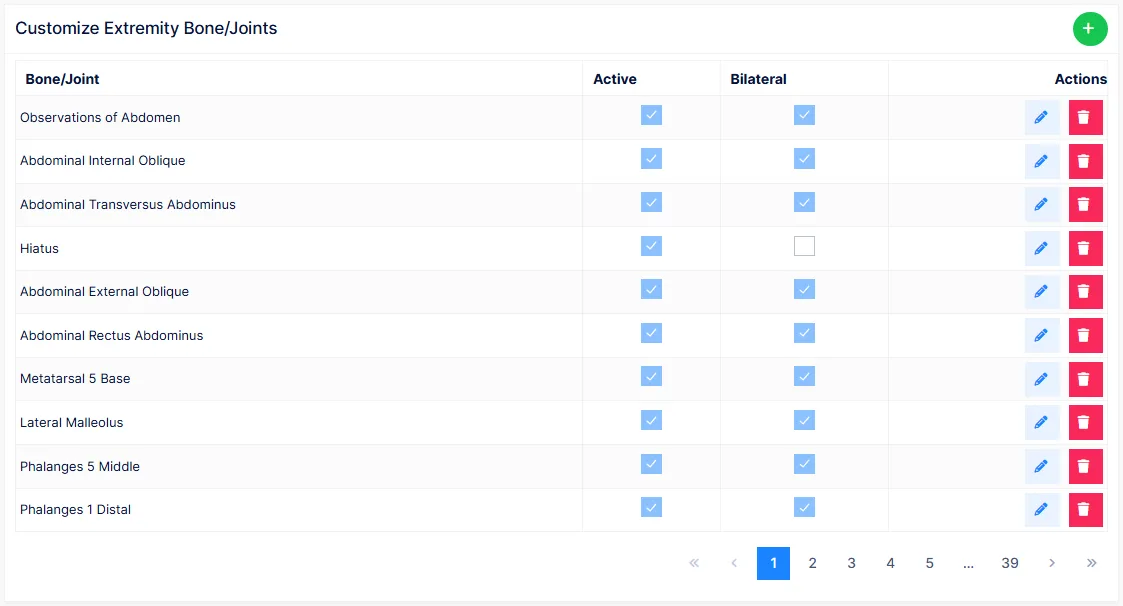
| Field | Notes |
|---|---|
| Bone/Joint Name | Required |
| Region | The region it is listed under. The regions list is the one from the Regions screen and cannot be edited here |
| Active | Whether it is offered on the Extremity screen |
| Bilateral | Whether it exists on both sides, so the screen asks for left or right |
Add a structure with the button above the list, edit or delete from the row actions.
Verbiage
The templates that build the extremity report, classified three ways:
| Classification | Values | Meaning |
|---|---|---|
| Group | Opening, Findings, Synonym | An opening sentence, a description of a finding, or an alternative name for a finding |
| Style | Sentence, Phrase | Opening templates must be sentences; synonyms must be phrases; findings can be either |
| Type | Depends on the group | For findings, which finding or family of findings the template describes and so which merge fields apply |
Select the group, style and type, step through the iterations, and edit, add, weight or delete them. The merge fields offered change with the type: opening templates take the examiner, patient, exam type and exam date; finding templates take the fields that finding needs.
Some finding types apply to several findings
A finding template of a given type may be shared by every finding of that type. Read the existing iterations before editing to see what the template must accommodate, and keep any edit general enough for all of them.
Synonyms are alternative names for a finding — "degenerative disc disease", "degeneration of the intervertebral disc" — chosen at random like any other iteration, so the report does not repeat the same term in every sentence. Every finding needs at least one.