
Appearance
Health
The patient's own medical background: what they have had before, what was done about it, and how they live.
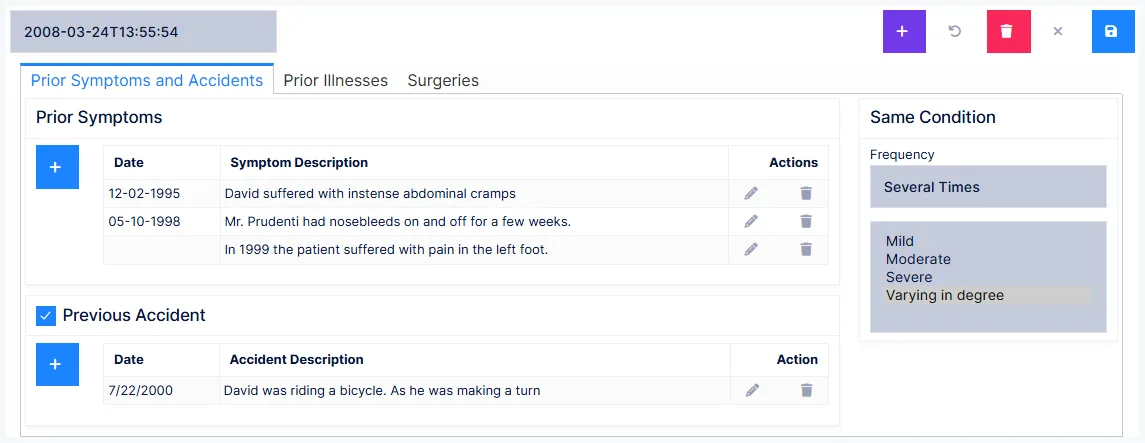
The screen has three tabs — Prior Symptoms and Accidents, Prior Illnesses and Surgeries — plus a Same Condition panel alongside the first.
Prior Symptoms and Accidents
Two dated lists, each with + to add an entry, and edit and delete on each row:
| List | Records |
|---|---|
| Prior Symptoms | Symptoms the patient has had before — date and description |
| Previous Accident | Earlier accidents, whether or not related to the current problem |
The Previous Accident list is switched on with its own checkbox, so a patient with no accident history simply leaves it clear rather than leaving an empty list.
Write descriptions as sentences about the patient
Every description field is prompted with "please start with the patient's name" — because the text flows into generated notes and narrative reports. "John fractured his left wrist in a fall" reads correctly in a report; "fx L wrist" does not.
Same Condition
Where a prior episode was the same condition the patient is presenting with now, record it here with its own frequency and severity — mild, moderate, severe, or varying in degree.
This is the pre-existing-condition question
When a carrier or attorney asks whether the current complaint pre-dated the incident, this is the field that answers it. Recording it accurately protects you either way — it is the absence of a clear answer that causes trouble.
Prior Illnesses
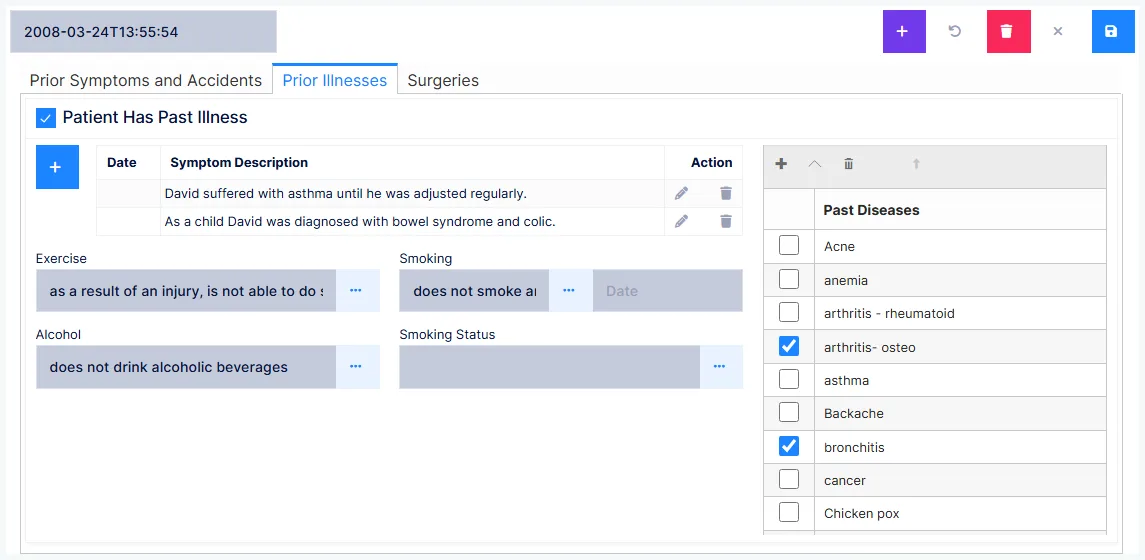
A dated list of significant past illnesses, switched on with Patient Has Past Illness, alongside the patient's lifestyle.
Lifestyle
Three of these are phrased as sentence fragments that complete "The patient…" in the generated narrative, so the choices read like "does a lot of walking every day" or "has an occasional beer":
| Field | What the choices cover |
|---|---|
| Exercise | From a sedentary life through to a couple of hours of vigorous activity daily, including "due to pain does not exercise" |
| Alcohol | From none, through occasional, to daily |
| Smoking | Cigarettes, chewing tobacco and snuff, including "quit smoking several years ago" and "has allergic reactions to cigarette smoke" |
Smoking Status is different — it is a coded status rather than a phrase:
| Status | Code |
|---|---|
| Current every day smoker | 1 |
| Current some day smoker | 2 |
| Former smoker | 3 |
| Never smoker | 4 |
| Smoker, current status unknown | 5 |
| Unknown if ever smoked | 9 |
Smoking Status is the reportable one
The Smoking phrase goes into the narrative. Smoking Status is the standard coded value that quality measures count — which is why it carries a code and its own date. Set both: the phrase for the report, the status for the measure. And update the status when it changes; a value captured once at intake and never revisited stops being true.
Surgeries
A dated list of past surgeries, plus two reference fields:
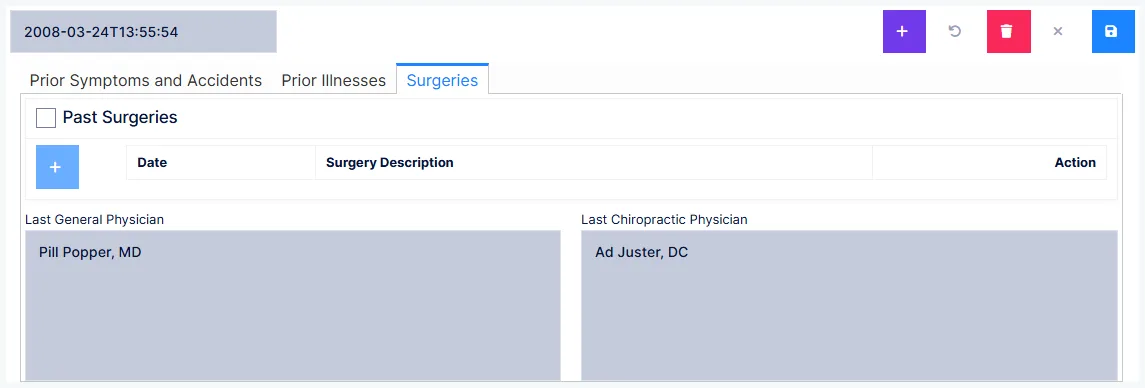
- Last General Physician
- Last Chiropractic Physician
Recording the previous chiropractor is worth the question
It tells you whether the patient has had care for this before, who to request records from, and — where relevant — what has already been tried.
Medications
Current and past medications are part of the health record.
"Medication" is broader than you'd expect
For Meaningful Use purposes the definition covers more than prescription drugs — it includes over-the-counter products and nutritional products: vitamins, minerals, herbals, nutraceuticals, homeopathic and naturopathic items.
Patients routinely don't mention these when asked what medication they take. Ask specifically.