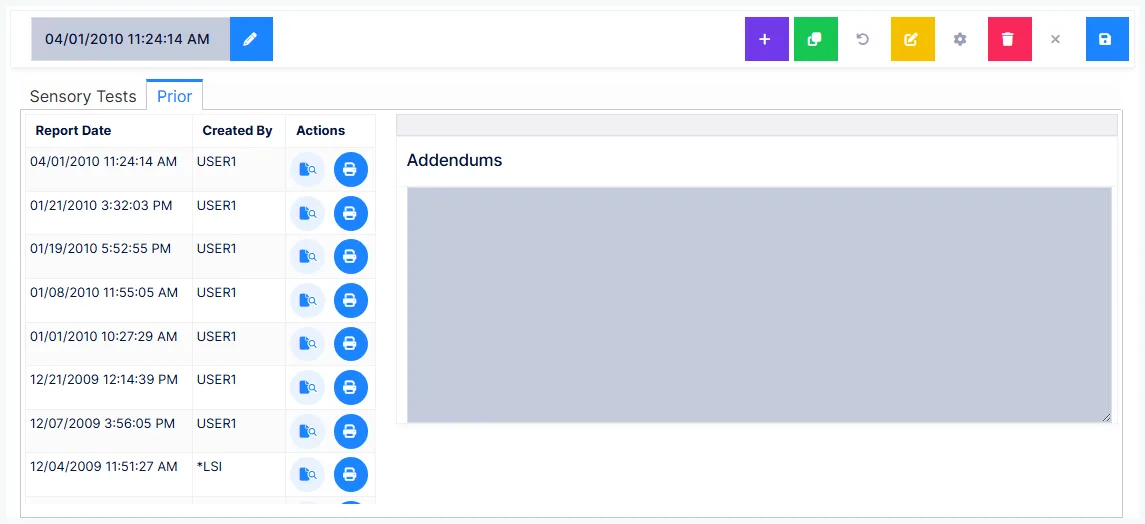
Appearance
Sensory
Two related things live on this screen: routine sensory testing — tendon reflexes and manual stimulation — and impairment grading against dermatomes and specific nerves.
They work independently, and both feed the same saved report.
Tendon reflexes and manual stimulation
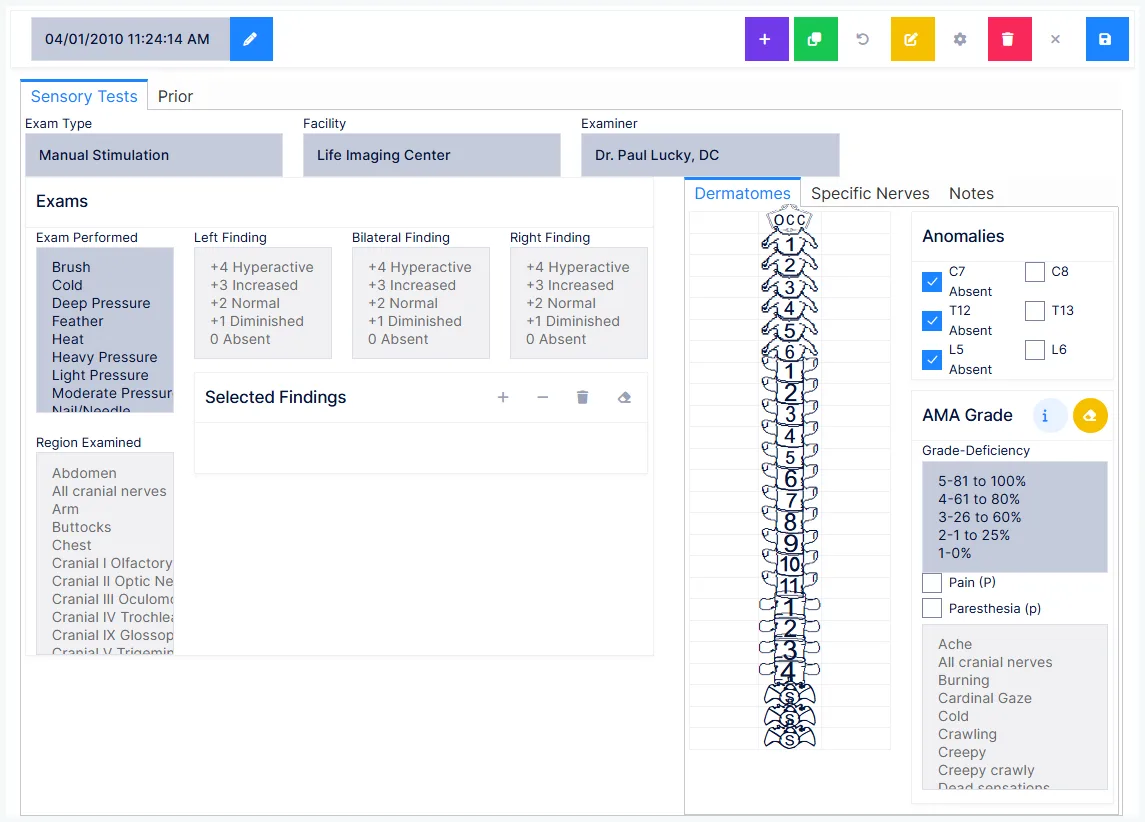
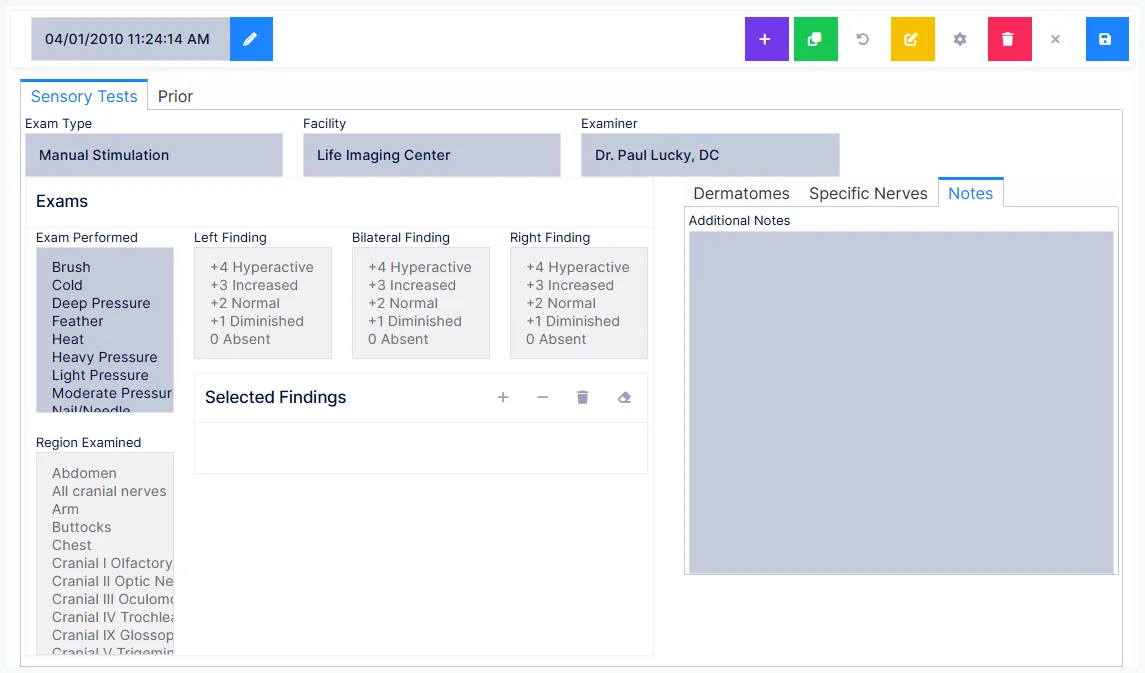
Choose the exam type, and the list of tests changes accordingly. Complete one category, switch the exam type, and complete the other — both accumulate into the same exam.
Manual stimulation needs a region, reflexes don't
Selecting a manual stimulation test — pressure, pinwheel, cold, hot, tuning fork — asks you which body region it was performed on. Tendon reflex tests go straight to the findings.
Findings are recorded in three boxes: Left, Bilateral and Right. Use bilateral when both sides gave the same result, and the left and right boxes when they differed.
Each is graded on the same scale:
| Grade | Meaning |
|---|---|
| +4 | Hyperactive |
| +3 | Increased |
| +2 | Normal |
| +1 | Diminished |
| 0 | Absent |
Recording several tests at once
Where a group of tests all gave the same result, select them together and apply the finding once rather than repeating yourself for each.
Dermatomes and specific nerves
This section grades sensory abnormality on the scale from the AMA's Guides to the Evaluation of Permanent Impairment — the scale used for impairment rating.
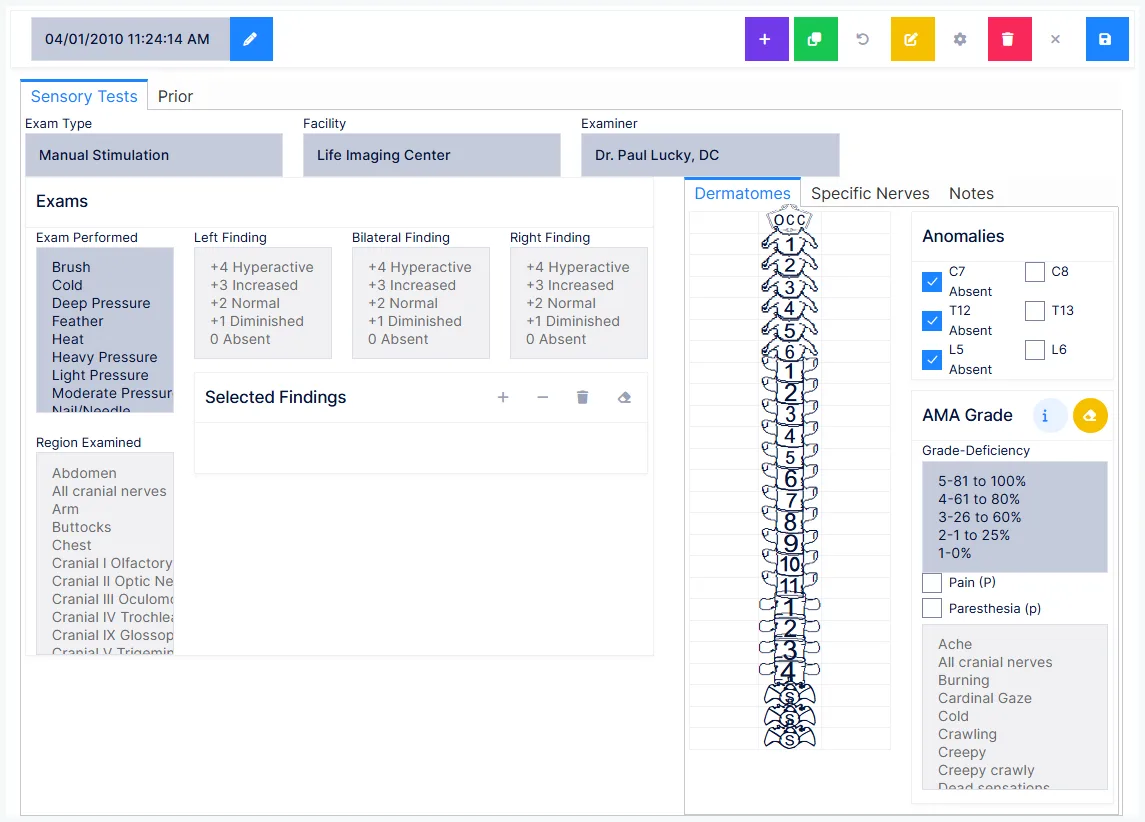
Dermatomes
Entry works like the Objective spine:
- Tick any anomalies — extra or missing vertebrae — first, so the spine is right before you place anything on it
- Choose the AMA grade
- Tick pain, paresthesia, or both
- If paresthesia, choose the types
- Click the level — the side column for one side, the middle column for bilateral
A grade needs pain or paresthesia with it
Recording an AMA grade requires you to also record the abnormal sensation the patient is experiencing — pain, paresthesia, or both. The grade alone is not a complete finding.
Capital P is pain, lowercase p is paresthesia
On the spine display the two are distinguished by case, so you can read both off the same diagram.
Specific nerves
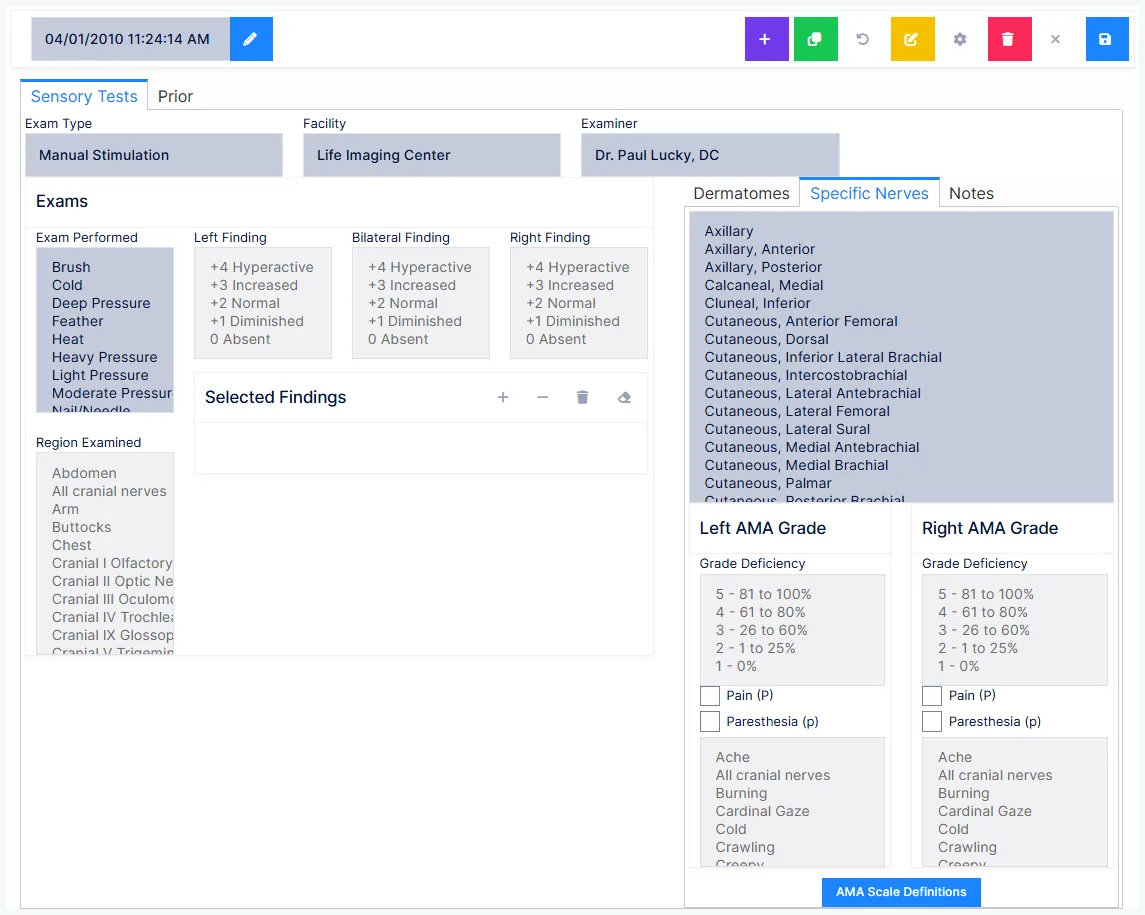
The same grading, applied to individual named nerves rather than dermatomes.
No bilateral here
Specific nerves are graded left and right separately. There is no bilateral option, so record each side.
The grades
Grades express the remaining deficiency:
| Grade | Deficiency |
|---|---|
| 5 | 81 – 100% |
| 4 | 61 – 80% |
| 3 | 26 – 60% |
| 2 | 1 – 25% |
| 1 | 0% |
Print the scale with the report
You can have the scale itself included in the report and the note, so anyone reading them knows what the grades signify — worth doing when the report is going to an adjuster or another practitioner who may not use the same scale daily.
Anomalies
The anomalies offered are the ones that actually shift the numbering — C7/C8, T12/T13 and L5/L6. Tick the ones that apply before placing findings.
Saving and rewording
Save generates the narrative. Each section has its own regenerate control — if the wording that came out isn't the one you want, regenerate just that section rather than the whole report.
Edit anything by hand, add to Additional Information, then OK – Save Changes to commit.
Committed reports are amended by addendum only
See the Exam overview.
Preferences
Defaults for exam type, facility, prescribing doctor, whether the note gets the entire report or selected sections, whether findings read as a list or as sentences, and whether the AMA scale is included. All overridable per exam.
Getting the exam into today's note
Same date, and saved before the note is generated
Both conditions apply, as with every examination screen — see the Exam overview.