
Appearance
Pain Scale
A visual analog scale the patient fills in themselves, rating their condition overall.
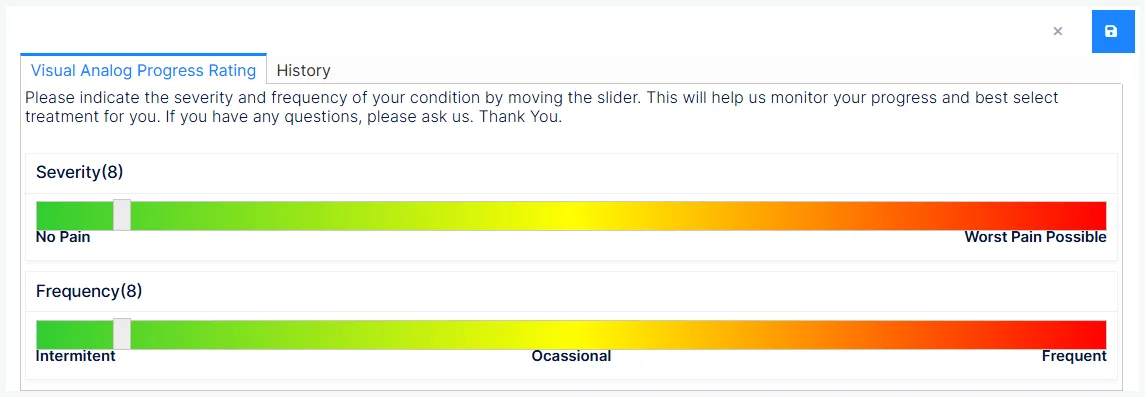
The screen is worded for the patient:
Please indicate the severity and frequency of your condition by moving the slider. This will help us monitor our progress and best select treatment for you.
Two sliders:
| Slider | Runs from | to |
|---|---|---|
| Severity | No Pain | Worst Pain Possible |
| Frequency | Intermittent → Occasional | Frequent |
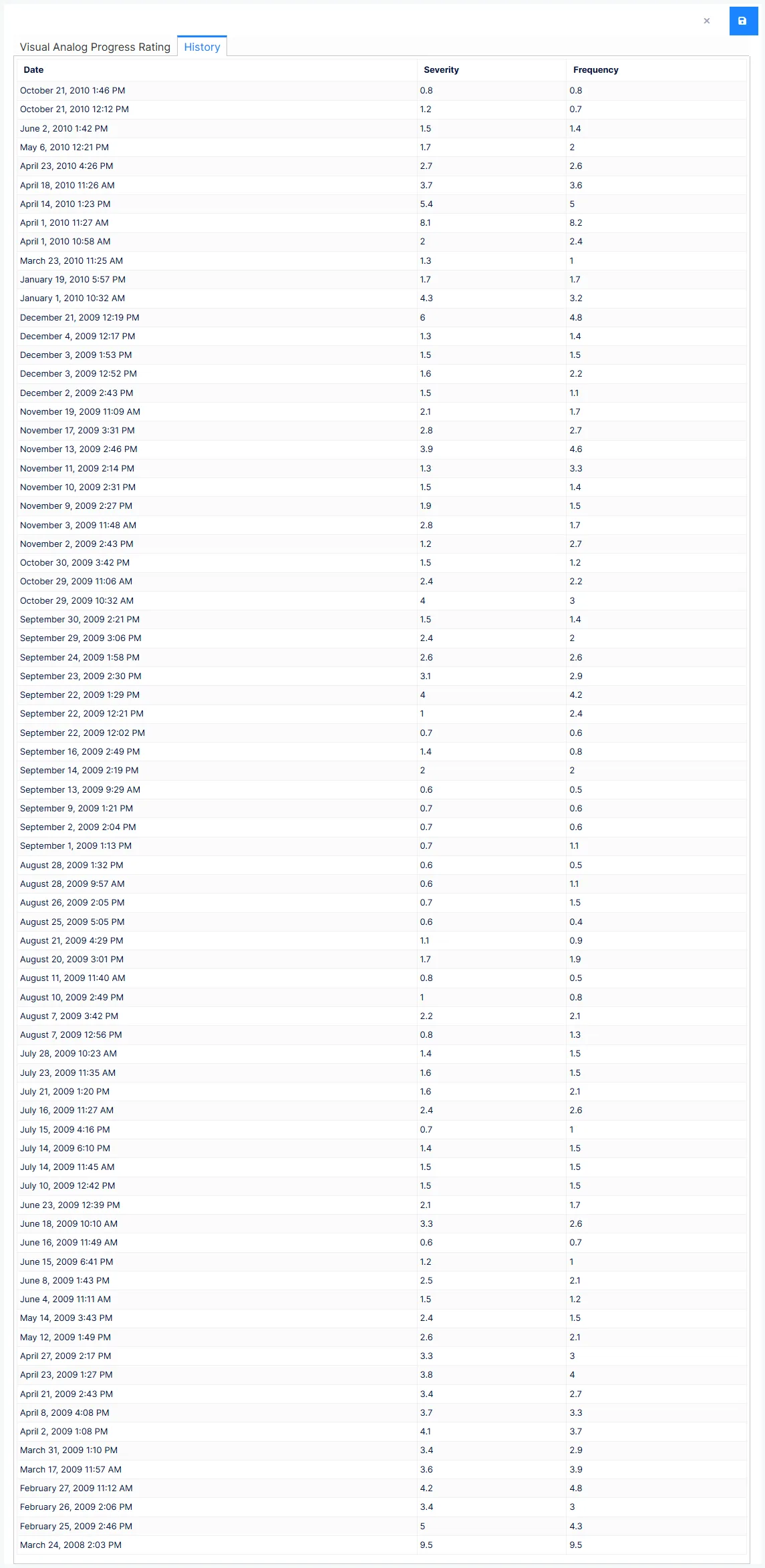
The History tab shows previous ratings, so you can see the trend across a course of care.
This is the overall rating
Individual complaints have their own 0–10 pain rating on Subjective. This screen is the patient's assessment of their condition as a whole.
Both are worth having
The per-complaint rating shows which problem is driving the presentation. The overall rating shows whether the patient feels better. A patient whose neck score improves while their overall rating doesn't is telling you something useful.
How Medicare treats it
A pain scale is subjective evidence, not objective
Medicare recognises the visual analog scale as a subjective finding only.
To produce an objective measure you need a Functional Outcome Assessment — and Medicare requires proof the patient completed it themselves, normally their signature. Record which form and the score on the Treatment Plan, and keep the completed form.
Record it every visit
Capture the rating on the first visit and on every visit after. Without a baseline and a series, there is nothing to demonstrate response to care — which is exactly what a carrier reviewing a course of treatment is looking for.
Whole numbers only
ChiroPad can be configured to report pain scores to several decimal places. Don't. A note recording pain as 6.824691 invites an examiner to ask how the measurement could possibly be that precise — and puts the rest of your documentation under the same scrutiny.