
Appearance
Auto Accident
The circumstances of a motor vehicle accident, in the detail a personal-injury case needs. Five tabs: Patient vehicle, Patient at impact, Other vehicle and Interior contact record what happened; Collision estimate turns it into a read-only estimate of how hard the vehicle was hit.
Why the questionnaire is this long
The mechanism of injury is what connects the patient's symptoms to the collision. Whether their head was turned, whether the headrest was positioned correctly, whether they saw it coming and braced — these change what injuries are plausible, and they are the questions an opposing expert will ask.
Asked at intake, they take a few minutes. Asked in a deposition two years later, they cannot be answered reliably.
Patient vehicle
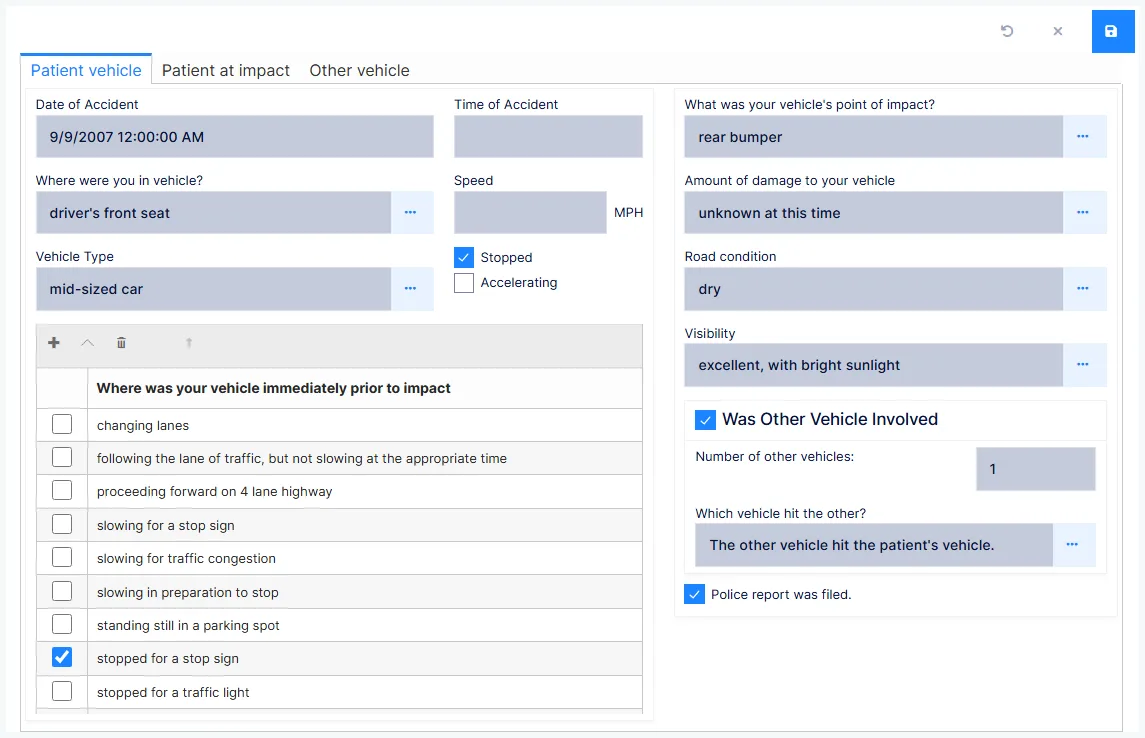
| Field | Choices |
|---|---|
| Date and time of the accident | |
| Where were you in the vehicle? | Driver's front seat, driver's side rear, passenger side front, right rear |
| Vehicle type | Compact, mid-size or full-size car, mini van, passenger van, SUV, passenger truck, motorcycle, construction dump truck… |
| Where was your vehicle immediately prior to impact? | Stopped or accelerating, and its speed |
| Year, make and model | Free text, e.g. 2019 Honda Civic |
| Repair estimate ($) | The dollar figure from the estimate or invoice |
| Event data recorder delta-V and EDR pulse duration | In mph and milliseconds, from a download of the vehicle's airbag control module |
| Point of impact | Front or rear bumper; left or right front fender, rear fender, or side |
| Direction the impact came from | A clock position around the patient's vehicle: 6 o'clock is directly behind, 3 o'clock the right side, 12 o'clock straight ahead |
| Amount of damage to your vehicle | A dollar figure, or minimal, almost not noticeable, or unknown at this time |
| Road condition | Dry, damp, wet, icy, muddy, sandy, gravel, leaves or debris, mostly dry with the first minutes of rain |
| Visibility | Excellent in sunlight or overcast; reduced at dawn, dusk or night; reduced by fog, rain or snow |
| Was another vehicle involved? | And which vehicle hit the other — the patient's hit theirs, theirs hit the patient's, or more than one vehicle was involved |
| Police report was filed |
"First minutes of rain" is there for a reason
Roads are at their most slippery just after rain starts, before the surface film washes away. It is a distinct condition, not a variant of wet, and the list treats it as one.
The event data recorder beats every other number on this screen
Most cars record the change in velocity of a crash in the airbag control module, even when the airbags do not deploy. A download — usually obtained through the insurer, the attorney or an accident reconstructionist — is measured, not estimated. When you have one, enter it: the collision estimate uses it in place of its own calculation.
Patient at impact
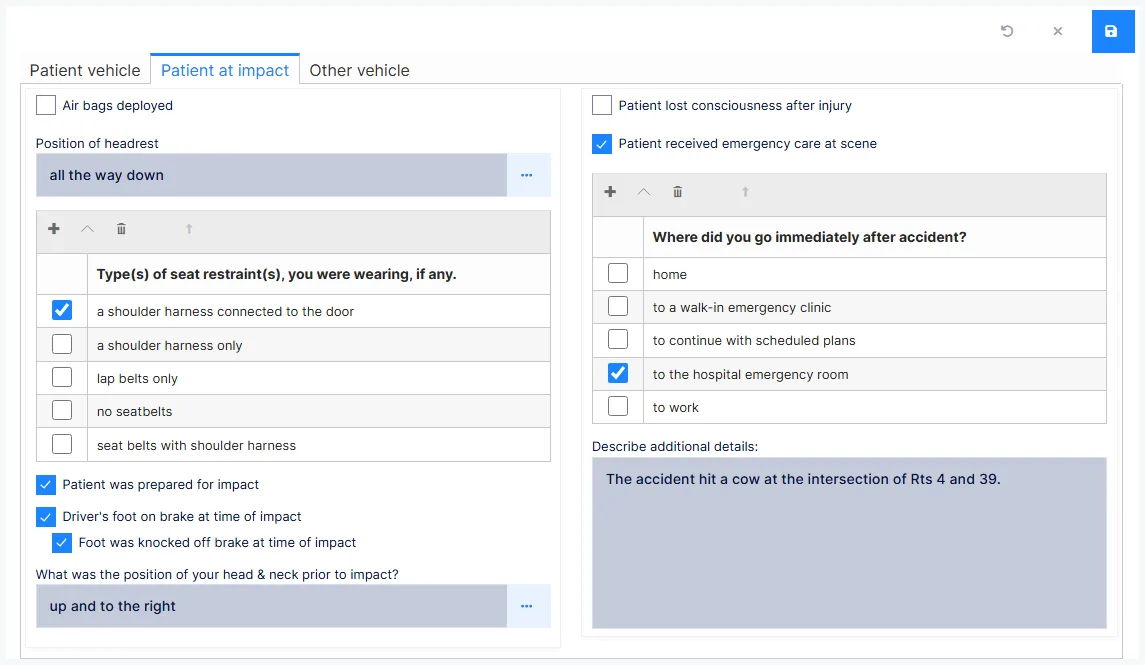
This tab is where the biomechanics live:
| Field | Choices |
|---|---|
| Seat restraints worn | Tick all that apply |
| Air bags deployed | |
| Position of headrest | Properly adjusted; adjusted high or low; all the way up or down; improperly adjusted and offered negligible protection |
| Head-to-headrest gap | The horizontal distance between the back of the head and the headrest, in cm |
| Headrest height vs head | At or above the top of the head; between the top of the head and the ear; below ear level |
| Seat recline | Upright, slightly reclined, reclined |
| Patient was prepared for impact | |
| Driver's foot on brake at time of impact | |
| Foot was knocked off brake at time of impact | |
| Position of head and neck prior to impact | Straight ahead; up or down; level, up or down combined with left or right |
| Patient lost consciousness after injury | |
| Patient received emergency care at scene | |
| Where did you go immediately after the accident? | |
| Describe additional details |
Head position and headrest are the two that get argued about
In a rear-impact case these fields do more work than almost anything else on the screen. A headrest set too low, or a head turned at impact, is a mechanism; a braced driver with a correctly positioned headrest is a different clinical picture entirely.
The gap and the height make that concrete. The gap is how far the head travels backwards before anything stops it; a headrest that sits below the head's centre can act as a pivot rather than a support. Adjusted low tells a reader something was wrong — 9 cm, below ear level tells them what.
Loss of consciousness changes the assessment
It is a yes/no field with disproportionate consequences — for the differential, for referral, and for how the case is viewed. Ask it explicitly rather than inferring it from silence.
Other vehicle
The same physical detail for the other vehicle where one was involved — its type, whether it was stopped or accelerating and its speed, what it was doing, its point of impact, its damage, its year, make and model, and its repair estimate.
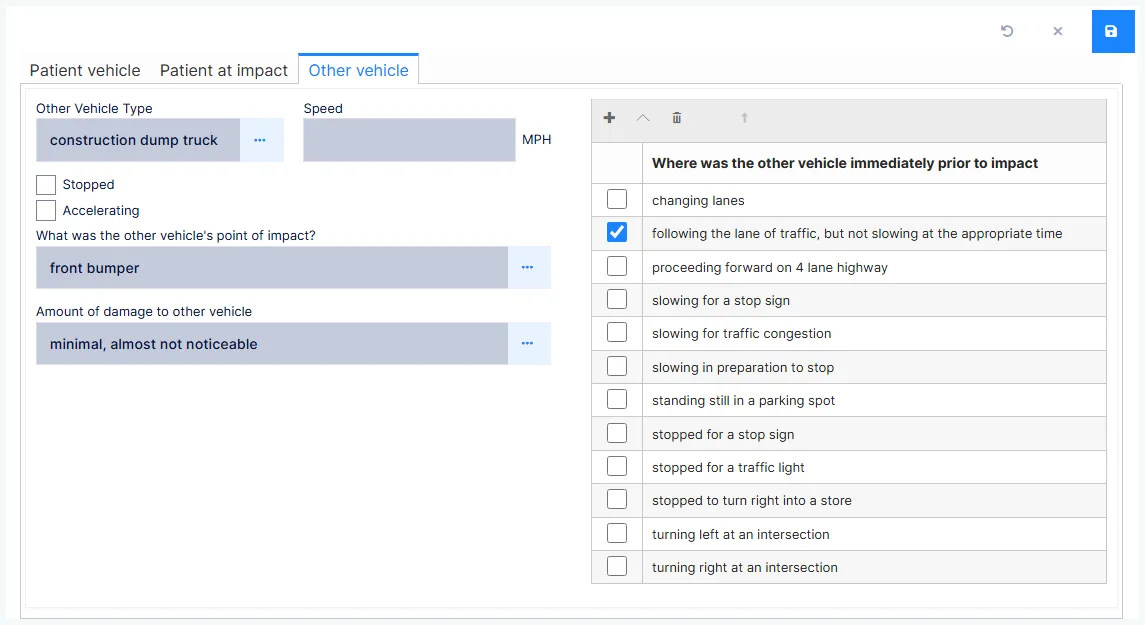
Clearing Was another vehicle involved? discards everything on this tab when you save.
Interior contact
Which parts of the patient's body struck the inside of the vehicle, and what they struck. Click Add contact for each one and pick a body area — head, face, neck, chest, abdomen, either shoulder, arm, knee or leg, or the pelvis — and what it struck: steering wheel, dashboard, windshield, side window, door, door pillar, roof, headrest, seat belt, air bag, center console, the seat in front, another occupant, or a loose object.
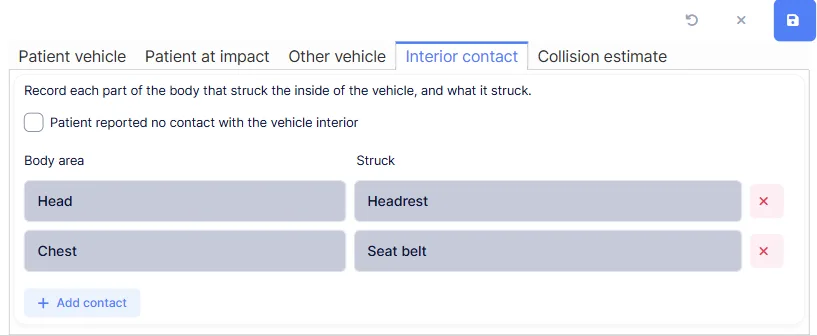
If the patient did not strike anything, tick Patient reported no contact with the vehicle interior rather than leaving the list empty. An empty list reads as not asked; the tick records that you asked and the answer was no.
Contact injuries are a different mechanism
A head against the side window or a knee into the dashboard loads that part of the body far more than the whipping motion of the collision itself. It is often what explains an injury that looks out of proportion to a low-speed crash — a concussion in a fender-bender, for instance — and it is worth recording even when it seems minor to the patient.
Collision estimate
A read-only estimate of how hard the patient's vehicle was hit, built from the last saved record. Save your changes to see them reflected — the tab refreshes after every save.
It is a range built on stated assumptions, not an accident reconstruction, and it is never added to narratives. Every number is shown with the assumptions that produced it.
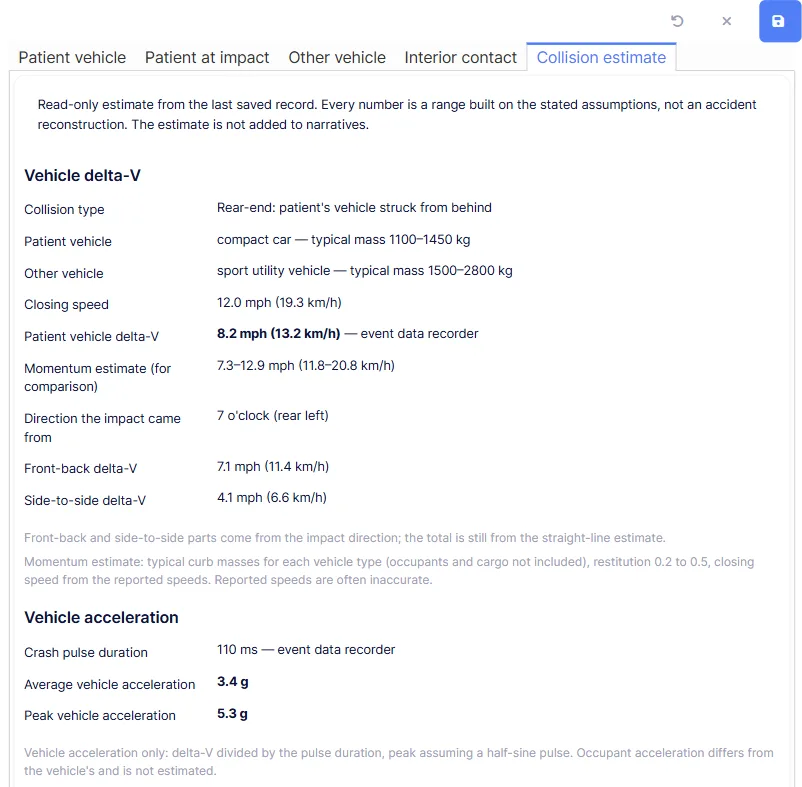
Vehicle delta-V
Delta-V is the patient's vehicle's change in speed during the impact — the standard measure of crash severity.
- With an event data recorder download, that figure is used, and the calculated estimate is shown beside it for comparison.
- Otherwise it is calculated from the two vehicles' typical weights and the reported speeds, as a range. The weights come from the vehicle type; a type the estimate cannot recognise is flagged rather than guessed.
The collision type comes from the two points of impact: struck from behind, struck the other vehicle's rear, head-on, struck on the side, or struck the other vehicle's side. When the other vehicle's point of impact is blank and the patient's vehicle was hit in the rear or side, the other vehicle's front is assumed — and the tab says so.
With a direction the impact came from, delta-V is also split into its front-back and side-to-side parts. An impact from 7 o'clock, 30° off straight behind, puts about 87% of it front-back and half of it sideways. If the direction contradicts the point of impact — a rear bumper hit from 3 o'clock — the tab flags it and does not split.
Reported speeds are the weak link
The calculated range is only as good as the speeds the patient gave, and people are poor judges of speed in the moment of a crash. Treat the range as a cross-check on the event data recorder and the repair estimate, not as a finding in its own right.
Vehicle acceleration
The average and peak acceleration of the vehicle, in g: delta-V over the length of the crash pulse. The pulse comes from the event data recorder when entered, and is otherwise assumed to be 90–150 ms, typical of a low-speed impact.
This is the vehicle's acceleration. The occupant's is different — the seat back springs and the head lags the torso — and it is not estimated.
Occupant, head and torso
The recorded facts that affect how the patient's head and torso moved, each with a note on why it matters: collision type, impact direction, whether a side impact struck the patient's own side, seat position, restraint, air bags, headrest position, gap and height, seat recline, head and neck position, and whether the patient was prepared. It then adds:
- Height, weight and BMI, from the Physical exam closest to the accident date that recorded them — the tab shows which exam it used.
- Sex and age at the accident, from the patient record.
- The interior contacts, with a note when the head or face was involved.
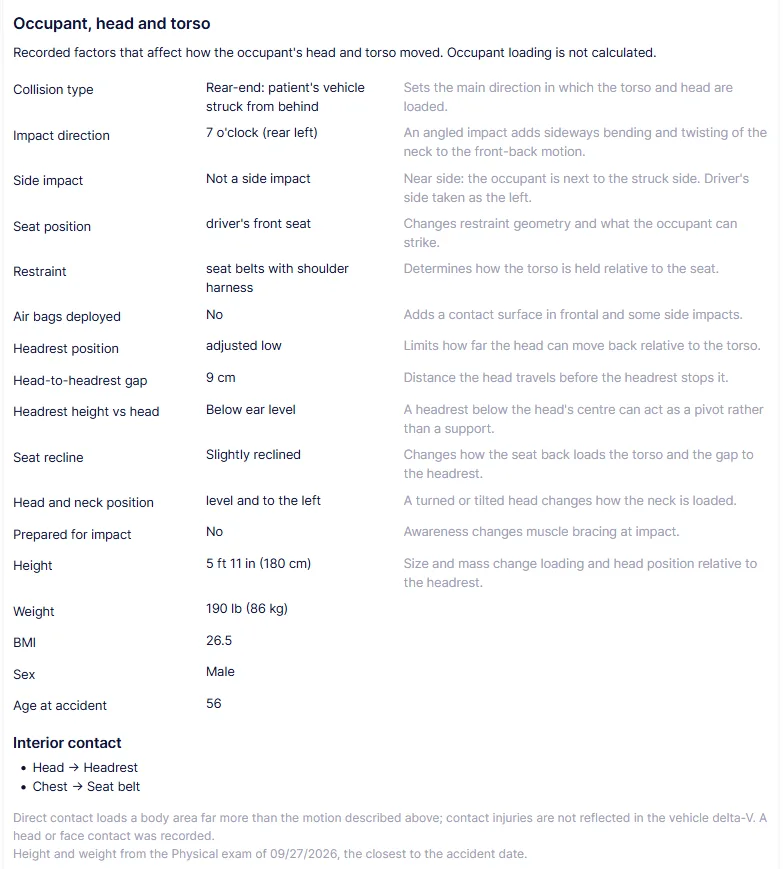
Nothing here is scored. The tab lays the facts out together; the clinical judgement is yours.
Timing of occupant motion
The typical sequence of occupant motion for a rear or frontal impact — for a rear impact, the seat back pushing the torso forward, the neck briefly forming an S-shape, the head moving back until the headrest stops it, and the rebound — with the crash pulse it happens within.
This is the textbook sequence, not a timing for this patient. Patient-specific timing needs seat properties and a measured crash pulse that the screen does not have.
Inputs that would tighten this estimate
A checklist of what is still missing — the event data recorder download, year, make and model, repair estimates, the headrest gap and height, seat recline, the impact direction, interior contact, height and weight, and the accident date. Fill these in and save, and the list shrinks.
In the narrative
Everything recorded here feeds the auto accident history in narrative reports — the Automobile narrative template, for instance. That includes the new detail: the vehicles' year, make and model and repair estimates, the event data recorder figures, the impact direction, the headrest gap and height, the seat recline, and each interior contact ("During the impact, his head struck the head rest and his chest struck the seat belt.").
The collision estimate itself is never narrated. Its numbers rest on assumptions that belong on screen next to them, not in a report.
To leave the vehicle's speed out of narratives, see Auto Accident – Hide Vehicle Speed in Preferences.
Getting the billing right
Recording the accident here does not route the claim. On the patient's policy, tick Auto Accident and select the state where the accident occurred — that is what sends it to auto insurance.