
Appearance
Assessment
Your clinical conclusion: how the condition stands, how the patient is progressing, the diagnosis, and the longer-term outlook.
Three tabs: Assessment, Diagnosis and Prognosis.
Each assessment is a dated record. The selector at the top defaults to a new one; choosing a past date brings up that earlier assessment.
Condition Status
Required on every visit
The condition status is a Medicare requirement and must be present in every SOAP note. It is also required by some state boards. A note without it may not support the claim built on it.
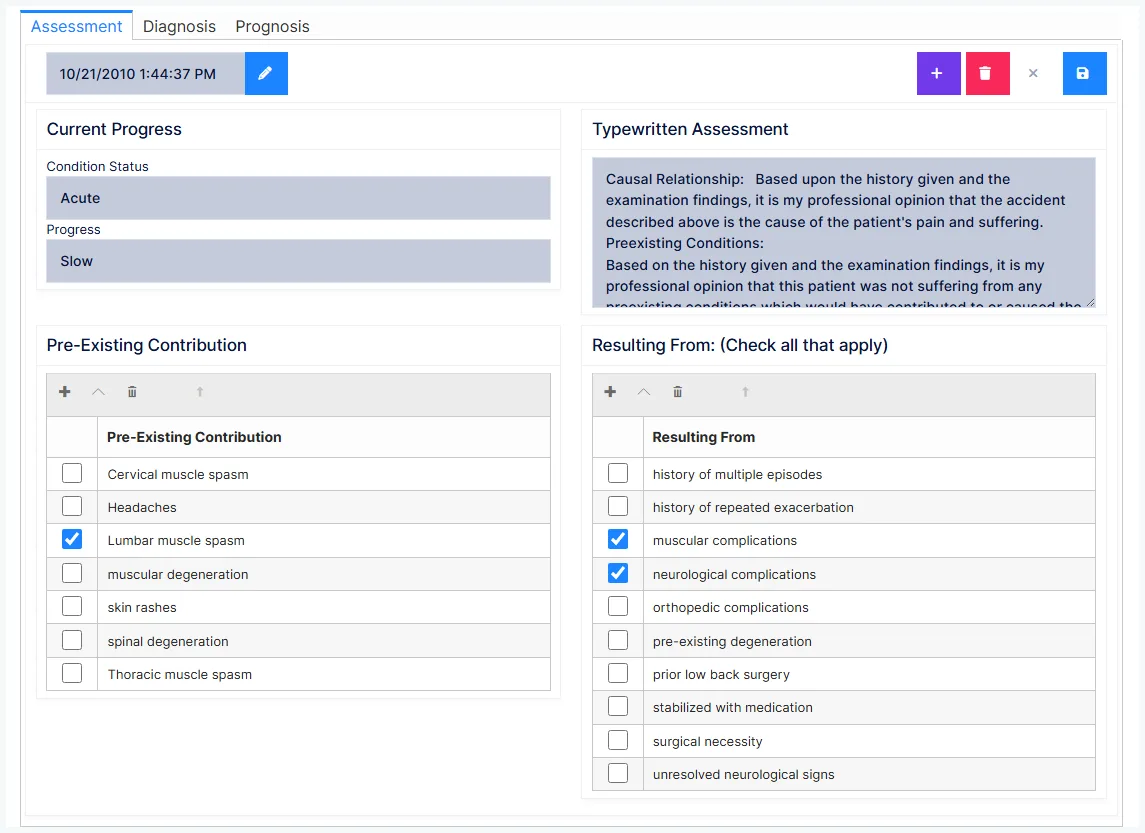
The available statuses cover the shape of a course of care:
Acute · Acute Exacerbation · Acute Flare Up · Acute Mild Exacerbation · Acute Moderate Exacerbation · Chronic · Chronic and permanent · Severely chronic · Episodic Flare Up · Episodic Periodic Care · Exacerbation of condition · Severe Exacerbation · Recurrence: Mild / Moderate / Severe · Improving · Plateau · Approaching MMI · Recovered · PRN
Progress
How the patient is responding: Good Progress, Good Response, Fast, Fair, Slow, Very Slow, Slow due to age, Slow due to weight, Guarded, Poor, Not Responding, or Too Early to say.
Required whenever you re-examine
Medicare and many state boards require the current progress to be recorded whenever a re-examination or re-evaluation is performed — and a patient under active treatment must be re-examined at least every 30 days.
Resulting From
A checklist explaining why the progress is what it is — history of multiple episodes, repeated exacerbation, muscular, neurological or orthopedic complications, pre-existing degeneration, prior surgery, stabilisation with medication, surgical necessity, unresolved neurological signs.
A selection on its own is thin documentation
The picklist gives the conclusion; Resulting From gives the reasoning; the narrative box gives the detail. Records that stand up to review usually have all three.
Adding an entry here adds it for everyone
You can type a new phrase into the blank row at the bottom of these lists. Once saved it becomes available in every patient's file, not just this one — these are shared lists, not per-patient notes. Word new entries so they make sense on somebody else's chart.
Pre-Existing Contribution
What the patient brought with them: cervical, thoracic or lumbar muscle spasm, headaches, muscular or spinal degeneration, and anything you add — plus a narrative box for detail.
Record it at the assessment, not later
This is your apportionment and causation record. Establishing what pre-dated the current episode is far more credible written at the time than reconstructed when a carrier or attorney asks.
Typewritten Assessment
Free text for the clinical reasoning that the picklists cannot carry.
Diagnosis tab
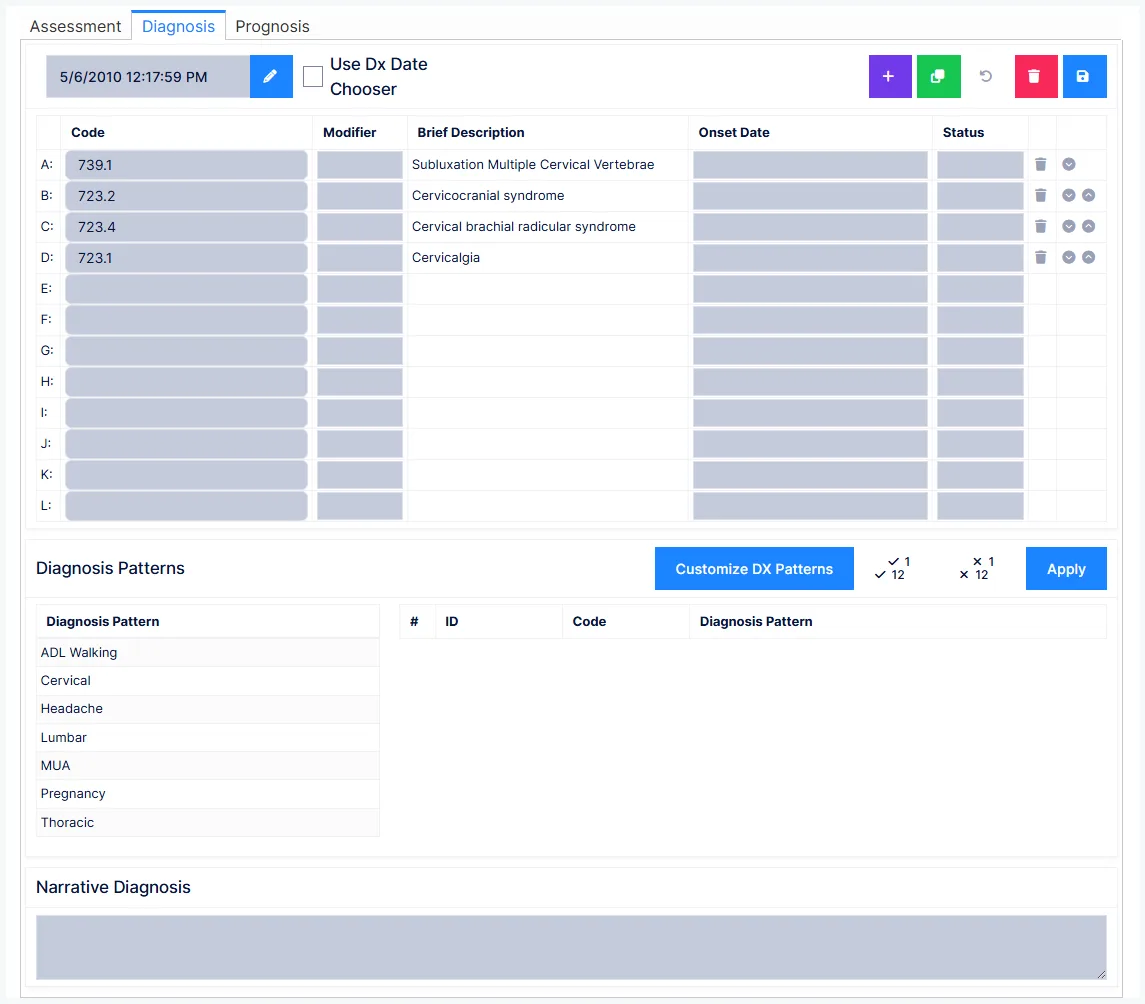
The patient's diagnosis set. This is the same diagnosis record used elsewhere in ChiroPad — see Diagnosis for the codes themselves.
The diagnosis is expected to move
Medicare expects the diagnosis to reflect a changing condition — which may mean revising codes or even reordering them as the patient improves. A diagnosis set that is identical for months argues that nothing is being reassessed.
Prognosis tab
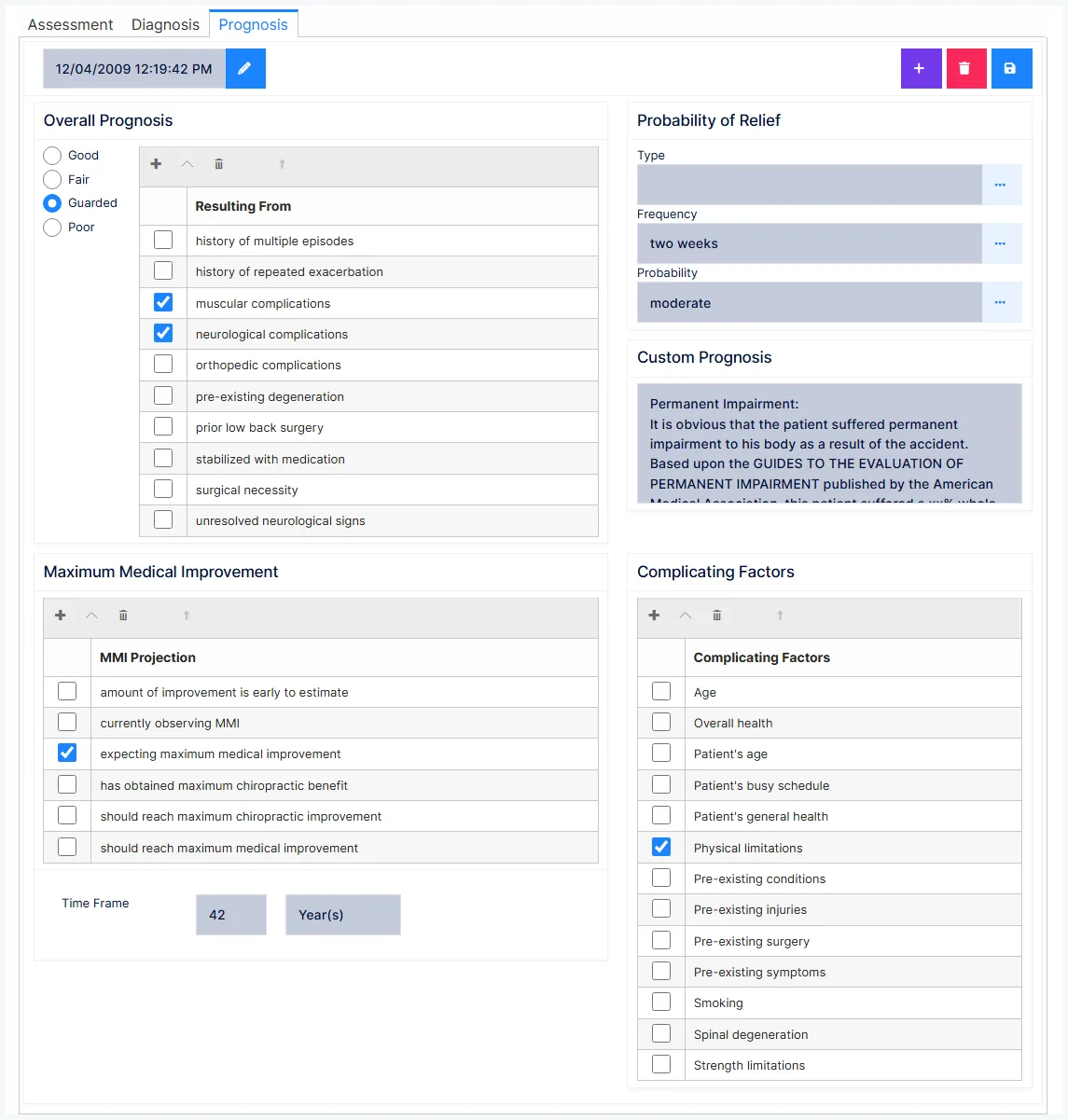
The longer-term outlook: overall prognosis, what it results from, probability of relief, expected maximum medical improvement and its time frame, and complicating factors.
Prognosis goes to narrative reports, not the visit note — unless you force it
By default everything on this tab feeds Narrative Reports and is left out of the SOAP note, however carefully you complete it. If a particular note genuinely needs the prognosis — a discharge, a report of findings — tick Force against Prognosis on the Generate screen for that note. For a routine visit, leave it out.