
Appearance
Immunization
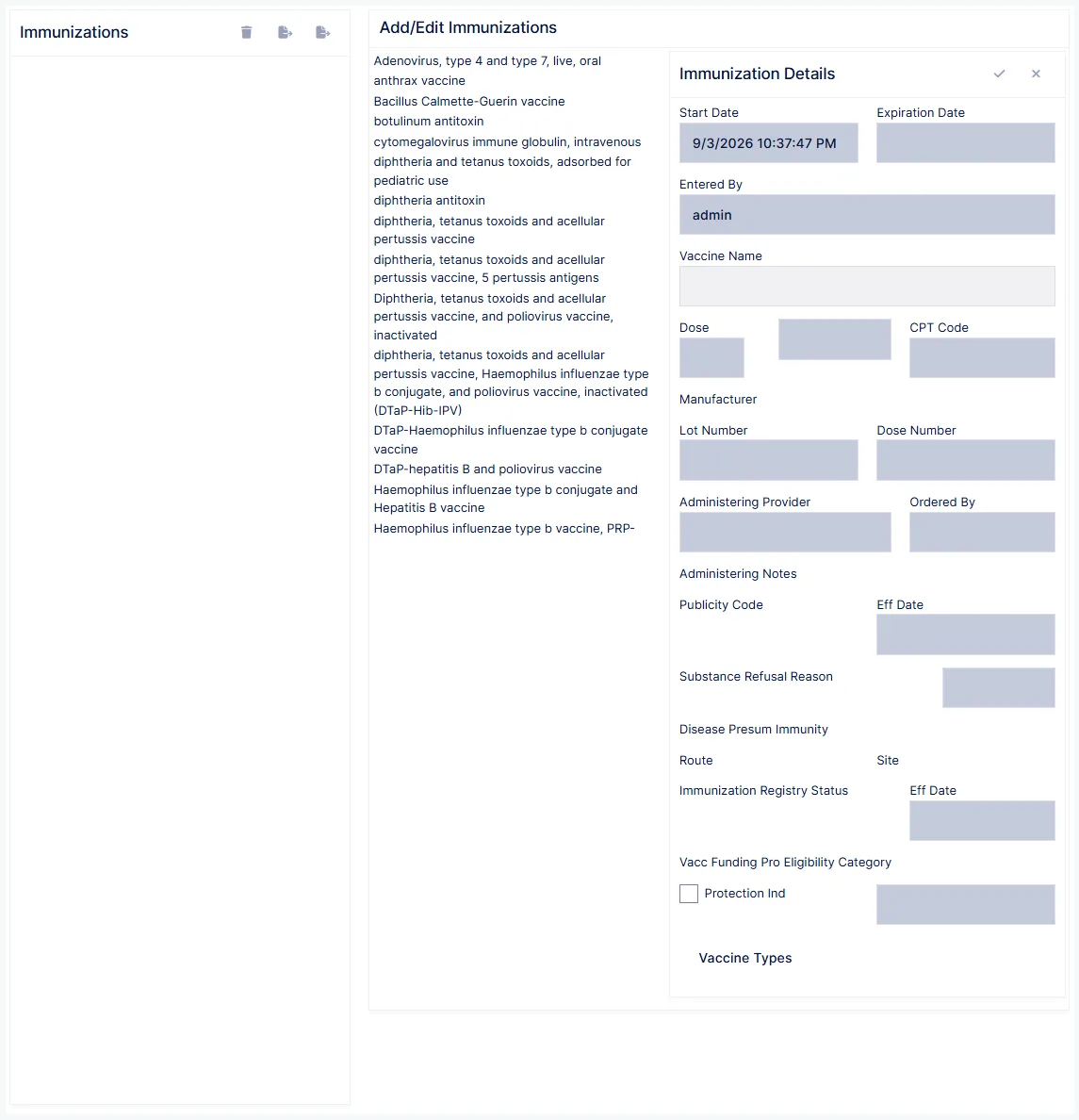
Vaccination records, held in enough detail to report to an immunization registry.
Recording a vaccination
| Field | Records |
|---|---|
| Vaccine type | From the CDC CVX code set — around 75 entries, each shown as code and name, e.g. 20 – diphtheria, tetanus toxoids and acellular pertussis vaccine |
| Full vaccine name | |
| Dose number | Which dose in the series, 1 to 10 |
| Administered | Date and time given, and the amount in ml, mg, mcg, iu, drops, puffs, or other units |
| Route and Site | How and where it was given, from coded lists |
| Lot number, expiration date, manufacturer | |
| CPT code | For billing |
| Ordered by and administering provider | |
| Administration notes |
Lot number and expiry are not optional detail
If a vaccine lot is later recalled, the lot number is what tells you which of your patients received it. It takes a moment at the time and is unrecoverable afterwards.
When a vaccine isn't given
The record also handles the cases where a vaccination did not happen:
- Substance refusal reason — with room for additional text
- Presumed immunity to the disease
Record refusals as deliberately as administrations
A refusal recorded as a refusal is a documented clinical conversation. A refusal recorded as nothing at all is indistinguishable from never having offered it.
Registry and funding fields
Several fields exist specifically for reporting rather than for your own chart:
| Field | Purpose |
|---|---|
| Immunization registry status | The patient's status with the registry |
| Publicity code | How the record may be used for reminder/recall |
| Vaccine funding program eligibility | Which programme covered the dose |
| Protect data | Restricts sharing of the record |
Vaccine Information Statement
The VIS — the CDC's patient information sheet for that vaccine — is tracked with the record.
Giving the VIS is a federal requirement
Federal law requires that the current Vaccine Information Statement is given before certain vaccinations, and that the fact is documented. Recording which VIS applied is how that is evidenced.
Exporting
Two exports are available:
- Immunization HL7 — the record in HL7 format for submission to an immunization registry
- Syndromic HL7 — for syndromic surveillance reporting
HL7 is the required format, not a convenience
Electronic submission to immunization registries is expected in HL7, which is why the record carries coded values rather than free text throughout. The coding is what makes the export usable at the other end.
Editing
Records track who entered them and when, and separately who last modified them and when — so a correction is visible as a correction.